GressusBass · Reference

How to Build a Scale on Bass

Fig. 1 — the Fretboard Visualiser
Full screen

Every neck diagram in this book is this tool. Choose a key and a mode; step through the five positions, or see the scale across the whole neck at once.
Most bassists learn scales as shapes. You are shown a pattern of dots, you play it up and down until your fingers know it, and it works — right up until someone asks you to play in a different key, or over a chord that is not the one you learned it against, and the shape turns out to have taught you nothing about the music.

A scale is not a shape. A scale is a formula — a fixed pattern of distances from a starting note. The shape is only what that formula looks like once it has been laid across four strings tuned the way a bass happens to be tuned.

Learn the formula and the shapes stop being twelve separate things to memorise. They become five views of one idea — the five positions the second half of this book is about.

Open the Fretboard Visualiser full screenPractise free with Gressus
How to Build a Scale01
GressusThe tool
Fig. 1 — the Fretboard Visualiser
Full screen

Every neck diagram in this book is this tool. Choose a key and a mode; step through the five positions, or see the scale across the whole neck at once.

Practise free with Gressus
How to Build a Scale02
Chapter oneFoundations

What a scale is

A scale is an ordered set of notes, chosen from the twelve available, that repeats at the octave. Play the set in order and you have a scale; play them in any other order and you have a melody. The set itself is what gives a piece of music its colour — the same tune played from a major set and a minor set is recognisably the same tune, in two different moods.

Two things define any scale:

A root

The note it is built from and returns to.

A formula

The distances of every other note from that root.

Change the root and you change the key. Change the formula and you change the type of scale. Those are separate decisions, and keeping them separate is most of the work.

The semitone, and the pattern

A semitone is the smallest step in Western music. On a bass it is one fret, on any string. Two semitones make a tone — two frets. Twelve semitones bring you back where you started, an octave higher, which on a bass is twelve frets up any string.

What a scale is03
Chapter oneFoundations

The major scale

The major scale is seven notes, and its pattern of steps is tone – tone – semitone – tone – tone – tone – semitone. Start on any note, apply that pattern, and you have a major scale.

Table 1 · The major scale, step by step
Step Note
— start C
+2 tone D
+2 tone E
+1semitoneF
+2 tone G
+2 tone A
+2 tone B
+1semitoneC

The minor scale

The minor scale has its own pattern: tone – semitone – tone – tone – semitone – tone – tone. The same seven steps as the major scale, with the two semitones in different places.

Table 2 · The minor scale, step by step
Step Note
— start A
+2 tone B
+1semitoneC
+2 tone D
+2 tone E
+1semitoneF
+2 tone G
+2 tone A

Two semitone steps, and where they fall is what makes a scale sound major or minor. Move them and you get a different scale entirely — which, as it turns out, is exactly what modes are.

Major and minor04
Chapter oneDegrees

Degrees: the numbers matter more than the names

Rather than counting steps every time, number the notes of a scale from its root. These numbers are scale degrees, and they are how musicians actually talk about scales.

Table 3 · Degrees: every interval from the root
Deg.NameSemitones
1Root / tonic0
♭2Minor second1
2Major second2
♭3Minor third3
3Major third4
4Perfect fourth5
♯4/♭5Tritone6
5Perfect fifth7
♯5/♭6Minor sixth8
6Major sixth9
♭7Minor seventh10
7Major seventh11
Degrees05
Chapter oneDegrees
Major scale1234567Minor scale12♭345♭6♭7

Every other scale in this book is described by how it differs from the top row. The minor scale is the first: the same row with the 3rd, 6th and 7th each lowered a semitone.

The reason to think in degrees rather than note names is that degrees travel. The ♭3 sounds minor in every key; the note E♭ only sounds minor in some of them. Once you hear degrees, you have learned the scale once instead of twelve times.

Spelling: one of each letter

A scale is not just a set of pitches, it is a set of named pitches, and the naming follows a rule: a seven-note scale uses each letter name exactly once. That is why the same pitch is sometimes written F♯ and sometimes G♭.

Table 4 · One of each letter: C, G and F major
C majorCDEFGAB
G majorGABCDEF♯
F majorFGAB♭CDE

G major's seventh has to be some kind of F, so it is F♯ and never G♭. F major's fourth has to be some kind of B, so it is B♭ and never A♯. Get the letters right and the accidentals follow automatically.

Spelling06
Chapter twoThe modes

One scale, seven starting points

Take the seven notes of C major and, instead of starting on C, start on D — same notes, same order, different home. It sounds different, because the pattern of tones and semitones has rotated relative to your new root. On a keyboard the seven notes of C major are the white keys, so a mode is simply where on the white keys you start.

Fig. 2 — the white keys, from C and from A
CTDTESFTGTATBSC
From C · major
ATBSCTDTESFTGTA
From A · minor

The same seven notes. From C the semitones fall between the 3rd and 4th and the 7th and 8th: major. From A they fall between the 2nd and 3rd and the 5th and 6th: the minor scale from page 4. You already know two modes.

The modes07
Chapter twoThe modes

Start on each of the seven white keys in turn and you get the seven modes of the major scale. Every mode has a parent major scale — the key whose notes it borrows. This matters enormously on bass, and it is the reason the positions chapter works the way it does.

Table 5 · The modes of C major
Mode of C majorNotes
C ionianCDEFGAB
D dorianDEFGABC
E phrygianEFGABCD
F lydianFGABCDE
G mixolydianGABCDEF
A aeolianABCDEFG
B locrianBCDEFGA
The notes are shared. The home is not.

Knowing that D dorian uses C major's notes does not mean playing C major and hoping. If the band is on Dm and you play a C major scale thinking “C”, you will keep landing on C, and over Dm that sounds unfinished, not like home. A mode is a sound you aim at, not a shape you get away with.

The parent key08
Chapter twoThe modes

From brightest to darkest

The white keys give the modes one order, Table 5. The ear hears another, from bright to dark. Laid out by degree, each mode in Table 6 lowers one note of the mode above it.

Table 6 · The seven modes, brightest to darkest
ModeDegrees
Lydianbrightest123♯4567
Ionianthe major scale1234567
Mixolydianmajor, bluesy123456♭7
Dorianwarm minor12♭3456♭7
Aeolianthe natural minor scale12♭345♭6♭7
Phrygiandark minor1♭2♭345♭6♭7
Locriandarkest, unsettled1♭2♭34♭5♭6♭7

The marked note is the one that has just been lowered. Lydian raises the fourth and is the brightest; Locrian flattens almost everything and barely feels like a home key at all.

The modes09
Chapter twoThe modes

Hearing it

Brightness is something you hear before you can name it. One root, seven modes, one note changing at a time.

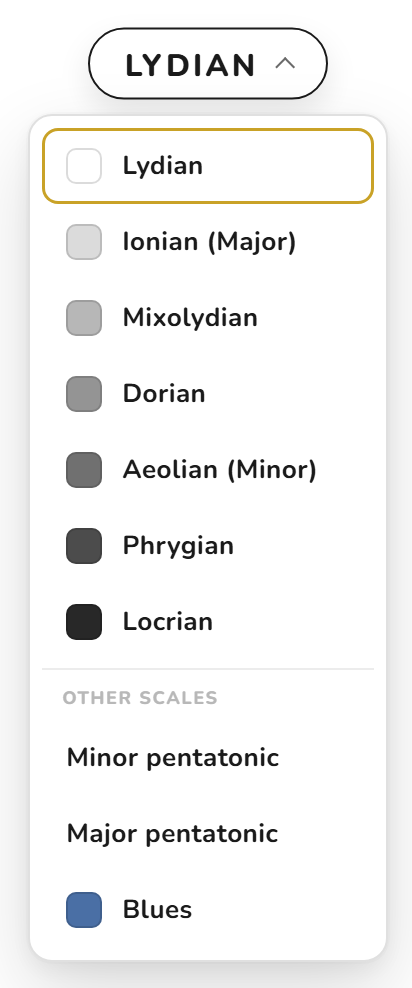
Fig. 3 — the mode list in the tool
The Fretboard Visualiser's mode list, open: the seven modes from Lydian to Locrian, each with its shade, then the other scales

The mode list in the tool: the first seven are the modes, brightest to darkest, in the same shades as Table 6.

  1. In the tool, choose E and Lydian.
  2. Let the open low E string ring, and play the scale up and back down on the strings above it.
  3. Choose the next mode in the list and play it again. Listen for the one note that has moved; Table 6 marks it.
  4. Carry on down to Locrian. Somewhere past Aeolian, E stops sounding like home.
Hearing it10
Chapter twoFamilies

The other scale families

The major scale is one family among several. Each is built from a different formula, and each has seven modes of its own, just as the major scale does. You don't need them all; these are the ones bassists reach for.

Melodic minor

The major scale with a ♭3, and nothing else changed. Its modes are the workhorses of jazz harmony.

Table 7 · Melodic minor and the modes bassists use
Melodic minor 12♭34567
Lydian dominant bright, and restless over a dominant chord123♯456♭7
Altered every tension a dominant chord can carry: a resolution held back1♭9♯93♯11♭13♭7

Harmonic minor

Natural minor with the seventh raised back up, which restores the pull home and opens a tone-and-a-half gap between ♭6 and 7. That gap is the sound.

Table 8 · Harmonic minor and the mode bassists use
Harmonic minor 12♭345♭67
Phrygian dominant the Spanish and Middle-Eastern sound, and a good deal of metal1♭2345♭6♭7

These modes can be ordered bright to dark too, but they don't change one note at a time, so the order is less use to the ear than the major scale's.

Families11
Chapter twoFamilies

Five notes, six notes, and the symmetrical ones

Pentatonic — five notes instead of seven. The major pentatonic is the major scale with the 4th and 7th removed; the minor pentatonic is its fifth mode. Between them they account for a great deal of the bass playing in rock, blues and funk.

Table 9 · The two pentatonic scales
Major pentatonic12356
Minor pentatonic1♭345♭7

Blues — the minor pentatonic with one extra note, the ♭5, sitting between the 4 and the 5. Six notes, and the extra one is a passing note more than a resting note.

Table 10 · The blues scale
Blues1♭34♭55♭7

Note the spelling: the ♭5 and the 5 share a letter name, which breaks the one-letter-each rule on purpose, because the sound is worth more than the tidiness.

Symmetrical scales are built from a repeating interval rather than a key. The chromatic scale is all twelve notes, a semitone apart. You won't play a tune in it; it is the set every scale in this book is chosen from. The whole-tone scale steps in tones throughout; the diminished scales alternate tone and semitone.

Why symmetrical scales have no positions

Because they repeat every few frets by construction, there is no five-position system to learn — the shape simply recurs.

Families12
Chapter threeThe fretboard

Why a scale is five shapes and not one

On a piano, C major is one physical thing: the white keys. On a bass it is not, and the reason is tuning. The four strings are tuned E A D G, the same notes as a guitar's lowest four strings, an octave lower. From the fourth string upward, each string starts a perfect fourth, five frets, above the one below it, with no exceptions.

Fig. 4 — four keyboards, one per string
GGABCDEFGDDEFGABCDAABCDEFGAEEFGABCDE4th4th4th0357912

Each string is a piano keyboard, one key per fret, starting on its open note: E, A, D and G. Ringed: where each string meets the next one up, five frets along, a perfect fourth every time. C, in its colour, lands at a different fret on every string.

One consequence follows, and it explains most of finding your way round a bass neck.

The fretboard13
Chapter threeThe fretboard

The same note exists in several places

So a scale is not a line on the bass: the same seven notes turn up again and again across the neck.

The practical answer is to learn the neck one hand position at a time.

A hand position

Put your first finger on any fret and let the other three fall on the next three frets, one finger each. That is a hand position: four frets on all four strings without moving your hand. Low on a bass neck the frets are wide, and many bassists cover three frets there instead, with the first, second and fourth fingers.

A position of a scale is every note of that scale under one hand position. Many players call it a box, and the tool draws an outline round it.

The fretboard14
Chapter fourPositions

Five positions cover the neck

Start at the nut in C major and move up one hand position at a time. Five positions take you to the 12th fret, each overlapping the next, and then the pattern starts again. The frets below are for C major only.

Table 11 · The five positions of C major, from the nut
ShapeFrets in CRoot
C0–33rd string, fret 3
A2–53rd string, fret 3
G5–84th string, fret 8
E7–104th string, fret 8
D9–132nd string, fret 10
C12–153rd string, fret 15

In another key every position slides along the neck by the same amount: in D, two frets higher. The shapes and their order stay the same.

Fig. 5 — C major, the five positions

Every C major note up to the 15th fret, with the five positions outlined. Each overlaps the next, and together they cover the neck; at the 12th fret the cycle starts again.

They overlap deliberately

The E-shape position ends at the 10th fret and the D-shape position begins at the 9th — two frets of shared ground. That overlap is the join. Practising the point where two positions meet, rather than each position in isolation, is what turns five shapes into one neck.

Positions15
Chapter fourArpeggios

The chord inside every position

The tool names each bass position with a letter, C, A, G, E or D: the names it uses on guitar, where each position is built round an open chord of that shape. A bassist doesn't play those chords. What matters is what they are made of: the root, 3rd and 5th of C, and all three sit inside every position.

Play those three in order and you have an arpeggio, the chord one note at a time. It is most of what a bass line is made from: the root to land on, the 5th to move to, the 3rd to say major or minor.

Where the letters come from

Go up the neck in C major and the positions arrive in the order C, A, G, E, D, then C again at the 12th fret. On guitar that order is the CAGED system; on bass it names five positions, so the two instruments share one map.

The five positions in C

Fig. 6 — C major, the C-shape position

Frets 0–3. The root, 3rd and 5th are proud, the rest of the scale half-lit.

Root, 5th, octave: one grip for every root

Because every gap is a perfect fourth, the grip never changes. From a root on the E, A or D string, the 5th is one string up and two frets along. From a root on the E or A string, the octave is two strings up and two frets along. And the 5th is also on the string below, at the same fret as the root.

Arpeggios16
Chapter fourArpeggios
Fig. 7 — C major, the A-shape position

Frets 2–5. The root, 3rd and 5th are proud, the rest of the scale half-lit.

Fig. 8 — C major, the G-shape position

Frets 5–8. The root, 3rd and 5th are proud, the rest of the scale half-lit.

Arpeggios17
Chapter fourArpeggios
Fig. 9 — C major, the E-shape position

Frets 7–10. The root, 3rd and 5th are proud, the rest of the scale half-lit.

Fig. 10 — C major, the D-shape position

Frets 9–13. The root, 3rd and 5th are proud, the rest of the scale half-lit.

Play the root, 3rd and 5th first, then the scale around them, without moving your hand. The arpeggio is the line; the scale is the four notes that join it up.

Arpeggios18
Chapter fiveModes on the neck

The idea most explanations skip

The five shapes belong to the key, not to the mode.

If you are playing D dorian, you are inside C major. C major's five positions are already sitting on the neck. You do not learn a new set of shapes for dorian — you play C major's shapes and treat D as home. What changes is not the geometry; it is which note you resolve to, which note you land on at the end of a phrase, and which note the band is calling home.

Because the positions stay put while the root moves, every mode of C major lives in the same five positions. What changes from mode to mode is which note in each position you treat as home.

To hear it, take the E-shape position at frets 7–10 and play it over a C major chord, ending your phrases on C. Then play the same position over a D minor chord, ending on D. Nothing under your fingers has moved, and the second sounds dorian.

Seven modes. Five positions. No new shapes at all.

That is the whole answer to "how do I play modes on bass", and it is why a bassist who has drilled the positions for years can still not use them: the shapes were never the missing piece. The missing piece was knowing which note is home, and hearing the difference when it changes.

Modes on the neck19
Chapter fiveModes on the neck
Fig. 11 — C ionian, the E-shape position
Fig. 12 — D dorian, the E-shape position

The same frets. The same notes. The same shape. Only the root has moved — and with it, the sound.

In the tool, change C ionian to D dorian and watch the positions stay where they are while the root markers move. That single interaction is this chapter in ten seconds.

Modes on the neck20
Chapter sixPentatonics

The pentatonic scales

The major pentatonic is the major scale with two notes left out, the 4 and the 7. They are not chosen at random. The major scale has only two semitone steps, 3 to 4 and 7 to the root, and the 4 and the 7 each sit at one of them. Those semitones are where a scale pulls and clashes. Take them out and no two notes are a semitone apart, which is why the pentatonic sounds open and sits over almost anything.

Fig. 13 — the major scale, minus the 4 and the 7
Major scale1234567
Major pentatonic12356

The marked notes are the 4 and the 7, one from each semitone step. What is left is the major pentatonic. In C they are F and B.

Fig. 14 — C major pentatonic: the G-shape position, without F and B

Frets 5–8 in C major, with its 4 and 7 marked. The five notes left are C major pentatonic, and they sit exactly where A minor pentatonic's do on the facing page.

Pentatonics21
Chapter sixPentatonics

The minor scale and its pentatonic

A minor uses C major's notes, so it lives in C major's positions: in the G-shape position at frets 5–8, treat A as home. Leave out its 2 and ♭6, B and F, the same two notes, and you have A minor pentatonic: C major pentatonic's five notes, with A as home.

Fig. 15 — A minor pentatonic: the G-shape position, without B and F

Every note of A minor, with the two left out marked. What you play is A minor pentatonic, the shape most players learn first.

One set of shapes. Two homes.

Major and minor pentatonic share every position; what changes is the note you land on. For A major pentatonic, play the same shapes three frets lower.

Minor and pentatonic22
Chapter sixBlues

Blues

Now add one note, but not one you took out: E♭, the ♭5, between the 4 and the 5. That is the blues scale: minor, minus two, plus one. Pass through the E♭ rather than resting on it.

Fig. 16 — A blues: the pentatonic plus E♭

The ringed note is the blue note, the ♭5.

A note on names, because conventions differ

This tool names each position after the guitar chord shape of the parent major key, so this one is the G shape. Many teachers instead number the minor pentatonic positions, with "box 1" the shape above. Both are internally consistent; they disagree because they answer different questions. Where this page and what you were taught differ, trust your ears and the frets, not the label.

Blues23
Chapter sixIn use

What each scale is for

A scale is only useful against harmony. This is the shortest honest summary of what fits where.

Table 12 · What each scale fits over
MajorMinorDominantDiminished
ScaleFits over
The seven modes, brightest to darkest
Lydian
maj7♯11maj9
Ionian
maj7add96
Mixolydian
7913
Dorian
m7m9m11m6
Aeolian
m7m9
Phrygian
m7sus♭9
Locrian
m7♭5
Pentatonic and blues
Major pentatonic
maj76add9
Minor pentatonic
m7m9
Blues
7m79m9
From the minor families
Phrygian dominant
7♭97♭9♭13
Lydian dominant
7♯1113♯11
Altered
7alt7♯9♭5
Symmetrical
Whole tone
7♯57♭5
Diminished
dim77♭9
In use24
Chapter sevenIn practice

In practice

Learn one position properly before learning five

The E-shape position, in one key, played until you can find any degree in it without counting, is worth more than five positions you can only play top to bottom.

Practise the joins, not the positions

The useful skill is moving between positions mid-phrase. Play a phrase that starts in the E-shape position and finishes in the D-shape position, deliberately crossing the overlap.

Say the degrees while you play

Not the note names — the degrees. It is slow and it feels ridiculous, and it is the single fastest route to hearing what you are playing rather than hoping.

Play scales against a chord, not against silence

A scale played on its own has no character. This is especially true of modes, which are essentially inaudible without harmony underneath.

Learn the pentatonic and the full scale as one thing

The minor pentatonic is the natural minor with two notes removed. Learning them separately is duplicated work.

In practice25
Chapter sevenQuestions

Common questions

Do I need to learn all five positions?

Eventually, but not all at once. Learn one position properly, then the position beside it, and practise the join between them, all in one key. Two positions that connect teach you more of the fretboard than one position carried through twelve keys, which only teaches you to move a shape. Once two or three positions join up in one key, take them to the others.

What is the difference between a mode and a scale?

None, mechanically — a mode is a scale. The word signals where it came from: dorian is what you get by treating the second degree of a major scale as home.

If D dorian has the same notes as C major, why name it?

Because the notes are not the music. Which note you resolve to, which notes you hold, and which chord sits underneath decide what a listener hears.

Why do bass shapes look so regular?

Because every gap between strings is a perfect fourth. A shape that works across two strings works across any two, so a line can move to another string and stay the same under your fingers.

Why are the positions named after guitar chords?

Because the tool uses one set of names for guitar and bass. On bass the letter is only a name; what matters inside each position is the root, 3rd and 5th, the arpeggio you build lines from.

Which scale should I learn first?

Minor pentatonic, then the major scale, then the modes of the major scale. In that order each is an addition to the last rather than a fresh start.

Do these shapes work on guitar?

Yes. A bass is tuned like the lowest four strings of a guitar, an octave lower, so every bass position is the bottom of a guitar position. The guitar edition adds the two top strings, and the one place its pattern bends.

Questions26
TOM · Teacher Of Music

The old textbook, brought to life.

Every diagram here is a tool you actually use — free, and built to practise with.

Practise free with Gressus
AboutPrivacyTermsContact

Gressus is a product of Gressus Ltd, registered in England and Wales, number 17376172.